02 · Emissions intelligence
Machine-learning blowdown detection on the SCADA data you already have.
Know what's venting, and what isn't. Nothing new on the lease.
For illustration purposes only.
7.2 billion
SCADA data points in training
1,250+
Wells tested & validated
3,500+
Operator-logged events in training
18+
Months of data
From the model's training and validation record.
What you get
Every detected event, on the record.
Detections
Every event: counted, dated, timed
Volumes vented
Measured in e³m³
Est. tCO₂e
Ready for reporting
Well by well
The breakdown, per site
What lands on your record, for every connected well.
The event ledger. Every detected vent: when, where, how long, how much.
Measured volumes. Quantified from the well's own data. Numbers ready for reporting, measured rather than estimated.
Mitigation planning. Rank the wells that vent most, plan the fixes first, and watch the ledger shrink.
Satellite coordination. Every detected event is cross-referenced against public methane-detection satellite passes, live and historical. You know which events were observable from orbit, when, and what those satellites could have seen.
The coordination runs across 21 satellites, mappers and taskables from multiple detection providers. Every pass is weighed by path, range, coverage and, above all, detection capability, with historical cloud cover analyzed over each event.
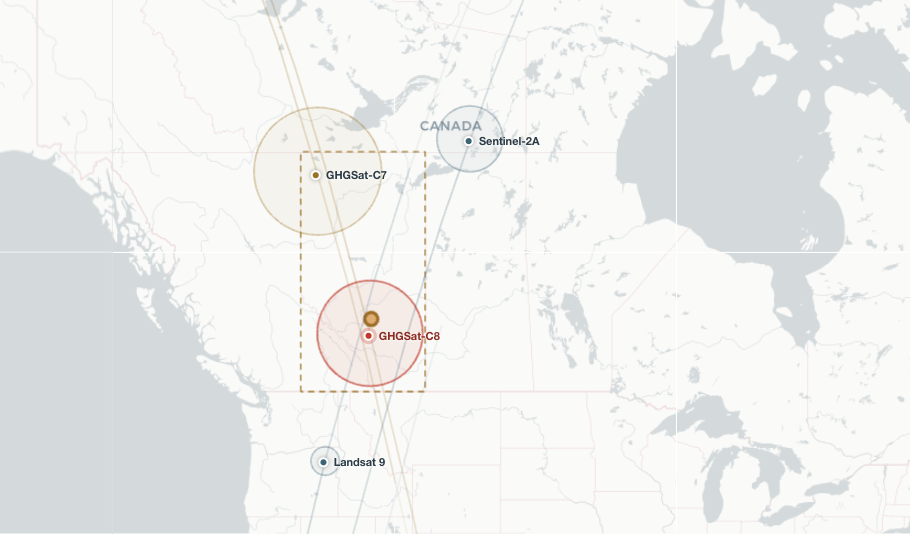
Live from the platform's overpass tracker: real passes, real footprints, the well inside one.
Every event
Checked against every pass
Observable
A satellite overhead during the vent
Clear sky
High capture probability
Cloud-obscured
Low capture probability
It all lands in your portal, branded for your company and scoped to your wells.
From the data you already run
No new hardware. No flyovers.
A blowdown, venting a well to atmosphere to clear its liquids, leaves a signature in the signals your wells already record. The detection models read it there.
Reads the signals you already record. Pressures, rates and valve states from your existing SCADA. No sensors to install, no cameras, no site visits.
Trained on real wells. Machine-learning models trained on live SCADA data and validated against operator field records.
Runs fleet-wide. Every connected well, screened continuously. Not a sample, and not an annual survey.
Why now
The clock is set.
Routine venting from facilities is prohibited from January 1, 2030, with limited exceptions, and methane targets tighten before then. Meeting the standard starts with knowing your numbers: measured, well by well.
Start with your data
Start with a look back.
Send us SCADA history and we'll run the models across it: the venting your record holds, found, measured and mapped into a historical venting report, with each event coordinated against satellite passes. From there, the same models run live.
And a vent in the ledger is production lost, not just methane. A well that vents repeatedly is a well worth fixing. See what Restore and Prevent do on the wells the models find.
Know your numbers first.
Talk to the team